I bought my copy of Vampire Hunter D for three dollars at a flea market in 1998. The VHS case had water damage and the spine was cracked. The tape itself had that fuzzy tracking problem where the bottom third of the screen kept rolling. I watched it twice that weekend.
There’s something about finding anime on damaged physical media that changes how you experience it. The imperfections become part of the memory. I can’t think about Vampire Hunter D without also thinking about that warped audio and the way Count Magnus Lee’s voice would dip into static during his monologues. It felt appropriate for a vampire movie. Like the tape itself was haunted.
Vampire Hunter D came out on December 21, 1985, directed by Toyoo Ashida and produced by Ashi Productions. It’s based on Hideyuki Kikuchi’s novel series, which started in 1983 and has since grown to over forty volumes. Forty. And we’ve gotten two movies out of it. The anime industry has a talent for leaving money on the table.
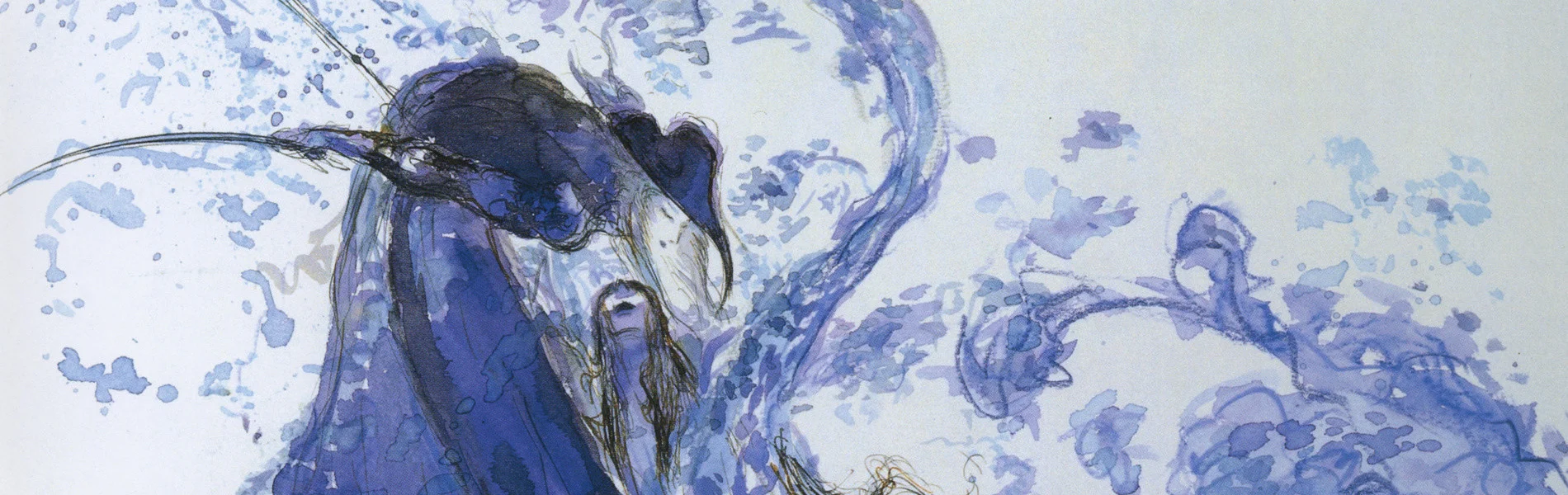
The setup is deceptively simple. In a far-future post-apocalyptic world where vampires rule as feudal nobility, a mysterious hunter named D takes a job protecting a young woman named Doris Lang after she’s bitten by Count Magnus Lee. D is a dhampir, half-human and half-vampire, which makes him an outcast on both sides. He carries a sword. He rides a cybernetic horse. He has a parasitic face embedded in his left hand that talks to him and occasionally helps out in combat. If you think that sounds like someone crossed a spaghetti western with Bram Stoker and then set the whole thing ten thousand years in the future, you’re not far off.
And that genre fusion is the film’s greatest trick. The setting looks like Transylvania but it’s actually Earth after nuclear war. The villages have that peasant-with-pitchforks energy but there’s laser technology mixed in. D himself is a ronin samurai who happens to also be a vampire slayer. He barely speaks. He walks into town, does the job, rides out. Shane with fangs. The whole thing plays like a western where somebody swapped out the dusty plains for gothic castles and nobody told the characters.
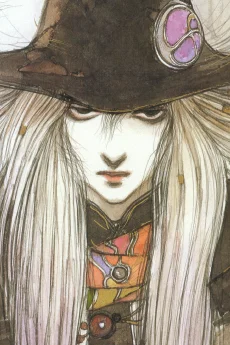
Yoshitaka Amano designed D, and you can see it in every frame he appears in. That androgynous face, the flowing cloak, the way he looks like he could be either the hero or the villain depending on the lighting. Amano had already made a name designing characters for Final Fantasy, and his aesthetic gives D a visual identity that no other anime character has replicated. When people talk about D decades after watching the film, they remember what he looks like before they remember what he does.
The problem is what he does. Or rather, how the film shows him doing it. The fight scenes in Vampire Hunter D are not good. I’ll say it plainly. D is supposed to be this unstoppable force, but the animation during combat sequences is stiff and choppy. Cuts happen before impacts land. The camera pulls back when it should push in. Ashida directed Fist of the North Star the same year and brought a similar roughness to both, but Fist of the North Star compensates with sheer over-the-top energy. Vampire Hunter D is going for atmosphere, and when the action breaks the atmosphere, you notice.

The film makes up for it everywhere else. The color palette is oppressively dark. Shadows pool in corners. Backgrounds have a hand-painted depth that digital production has never quite matched. There are shots of D walking through empty landscapes at dusk that communicate loneliness better than any dialogue could. One reviewer I saw online said you need to watch this film at night with every light in your house turned off, and he’s right. The darkness is the point. If you’re straining to see what’s happening in some scenes, that’s not a bug. That’s the world D lives in.
The English dub is its own experience. The original Streamline Pictures dub from the early ’90s is the one most people my age grew up with. It’s cheesy. The performances are uneven. But it has a charm that the 2015 Sentai re-dub completely lacks. The new dub gave characters weird Southern accents that come and go without explanation. If you can track down the Streamline version, that’s the one to watch. It matches the VHS-era experience the film was born into.
Doris Lang deserves better than what the film gives her. She starts strong. A frontier woman defending her farm, shooting monsters, holding her ground. Then D shows up and she becomes the person who needs saving. Kikuchi’s novel handles her with more agency, but the film slots her into a damsel role by the midpoint and keeps her there. It’s a product of 1985, and I’m not going to pretend that excuses it. Her brother Dan gets more screen time in the final act than she does.
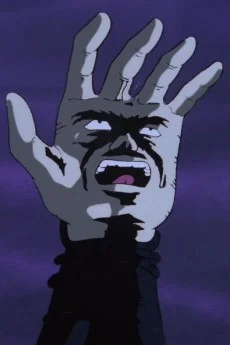
The Left Hand — that face in D’s palm — is the weirdest supporting character in ’80s anime, and that’s saying something for a decade that gave us Chim-Chim the chimpanzee hiding in trunks. He’s comic relief in a film that otherwise takes itself completely seriously. He cracks jokes. He offers unsolicited advice. At one point he saves D’s life by sucking out poison. The contrast works because D never acknowledges the absurdity. He treats the face in his hand the way you’d treat a coworker who talks too much. With patience and visible exhaustion.
Count Magnus Lee is a decent villain in the theatrical sense. He commands the screen when he appears. But his motivations don’t extend past “I want this woman because I’m a vampire and that’s what vampires do.” The film gestures toward deeper themes about desire and conquest versus restraint. D represses his vampire half out of moral conviction. The Count indulges his without limit. There’s something there, philosophically, but the film doesn’t develop it past implication.
Here’s the thing about Vampire Hunter D that gets lost in the nostalgia debates: it matters less as a film than as a cultural event. This was one of a handful of anime titles that made it to American VHS shelves in the late ’80s and early ’90s. Alongside Akira and Robotech and a few others, it was the proof that anime could be something other than Saturday morning cartoons. A generation of fans discovered the medium through a water-damaged flea market tape of this exact movie. The film itself is uneven. What it represented was not.
Kikuchi kept writing D novels through the ’80s, the ’90s, the 2000s, and he’s still going. Over forty volumes exploring a world that the film barely scratched the surface of. There are entire novels about D wandering through post-apocalyptic landscapes that feel more like Cormac McCarthy than Bram Stoker. The anime community has been begging for more adaptations for decades. Two films out of forty-plus novels is a crime against the source material. If you’ve been curious whether the books are worth tracking down after the films, the novels go places the anime never touched.
If you’ve seen the Netflix Castlevania series and wondered where that aesthetic came from — the brooding vampire lord in his castle, the lone hunter with inhuman abilities, the gothic European architecture crumbling under supernatural decay — this is the answer. Vampire Hunter D did all of it fifteen years earlier with a fraction of the budget. Kawajiri himself would go on to direct Ninja Scroll and Wicked City, both of which share D’s DNA. The entire dark fantasy anime genre traces back to this film and Kikuchi’s novels.
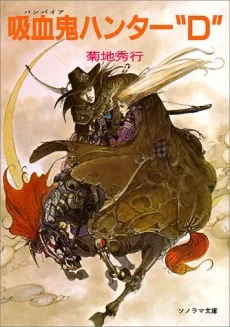
The 2000 sequel, Vampire Hunter D: Bloodlust, is better in every measurable way. Directed by Yoshiaki Kawajiri at Madhouse, it has fluid animation, tighter pacing, a more complex plot, and fight scenes that actually deliver on D’s reputation. If you only watch one Vampire Hunter D film, the community will tell you to watch Bloodlust. They’re right. It’s the superior movie.
But I’d still tell you to watch the 1985 film first. Not because it’s better. Because context changes how you experience art. Watching D emerge from shadow in hand-painted darkness, hearing that crackly Streamline dub, feeling the film strain against its budget while reaching for something genuinely atmospheric — that’s the version of Vampire Hunter D that turned an entire generation into anime fans. Bloodlust is the reward. The original is the origin story.
I sometimes wonder what Kikuchi thinks about the fact that his forty-volume epic is known to most Western fans through an 80-minute movie with choppy fight scenes and a debated dub. Probably the same thing Tolkien would have thought about the Rankin/Bass Hobbit. Grateful that it got people reading, frustrated that they stopped at the cover.
My flea market VHS finally gave up around 2005. The tape snapped during the scene where D fights Rei Ginsei. I bought the DVD, then eventually the Blu-ray, and the picture quality improved dramatically. But I’d be lying if I said I didn’t miss the static.